
Supplementary Material of ‘Visualizing the Sidney Network: Using Network Analysis to Understand Women’s Place.’
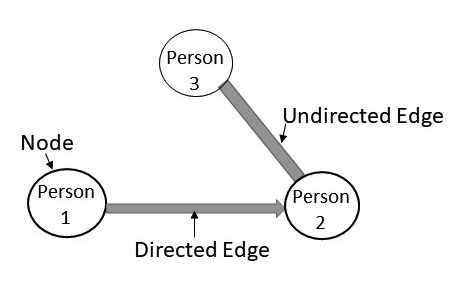
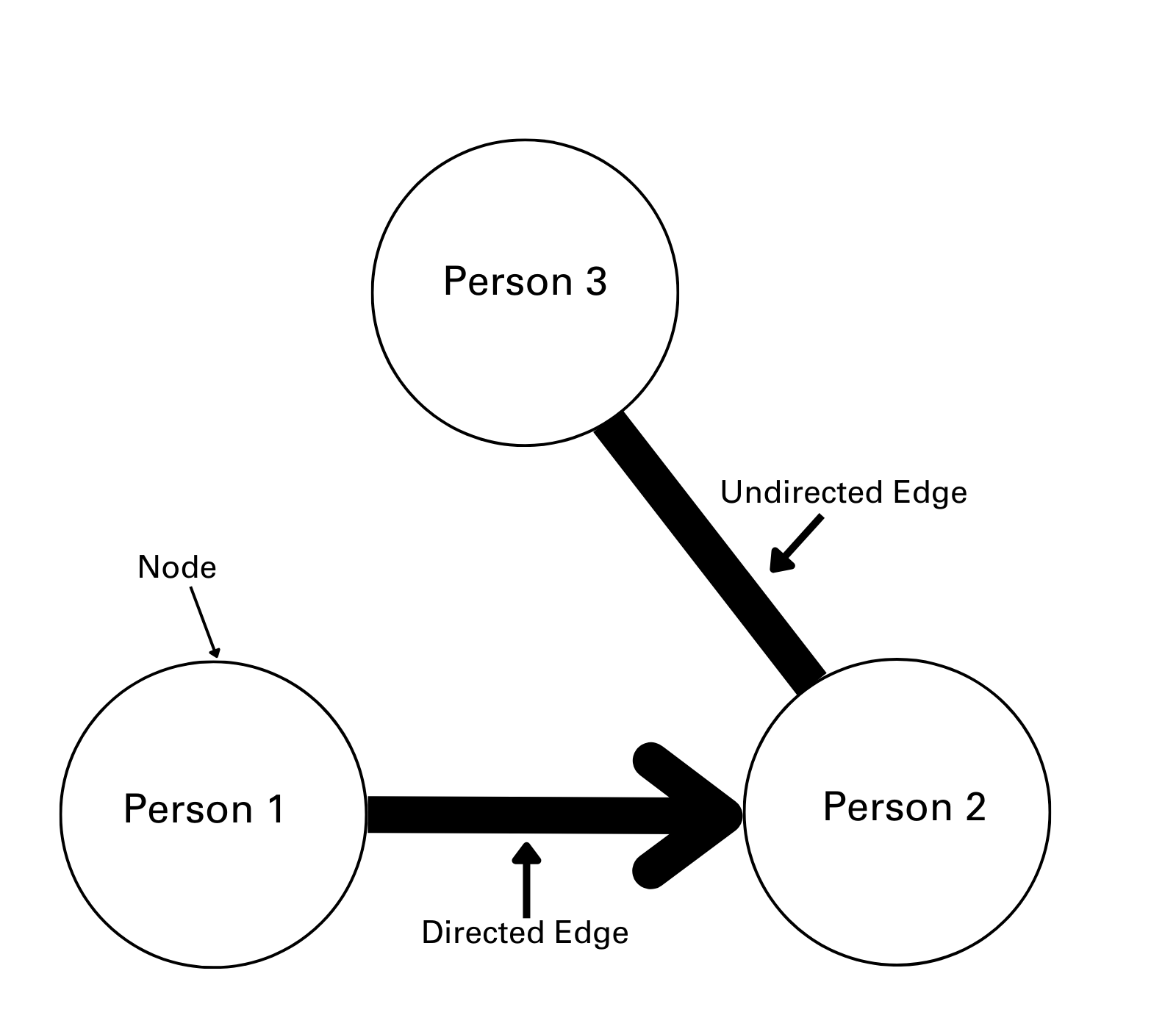
Figure 1. Node and edge diagram.
Figure 2. The Sidney network colored by modularity. The colors/shades represent the five distinct groups within the network centered on Robert Sidney, Rowland Whyte, Henry Sidney, Queen Elizabeth, and…
Listed in Image | publication by group Iter Community
Version 2.0 - published on 27 Jul 2026 doi:10.25547/NQ4W-TS97 - cite this
Licensed under Creative Commons BY-NC 4.0

Description
Figure 1. Node and edge diagram.
Figure 2. The Sidney network colored by modularity. The colors/shades represent the five distinct groups within the network centered on Robert Sidney, Rowland Whyte, Henry Sidney, Queen Elizabeth, and Turlough O’Neill.
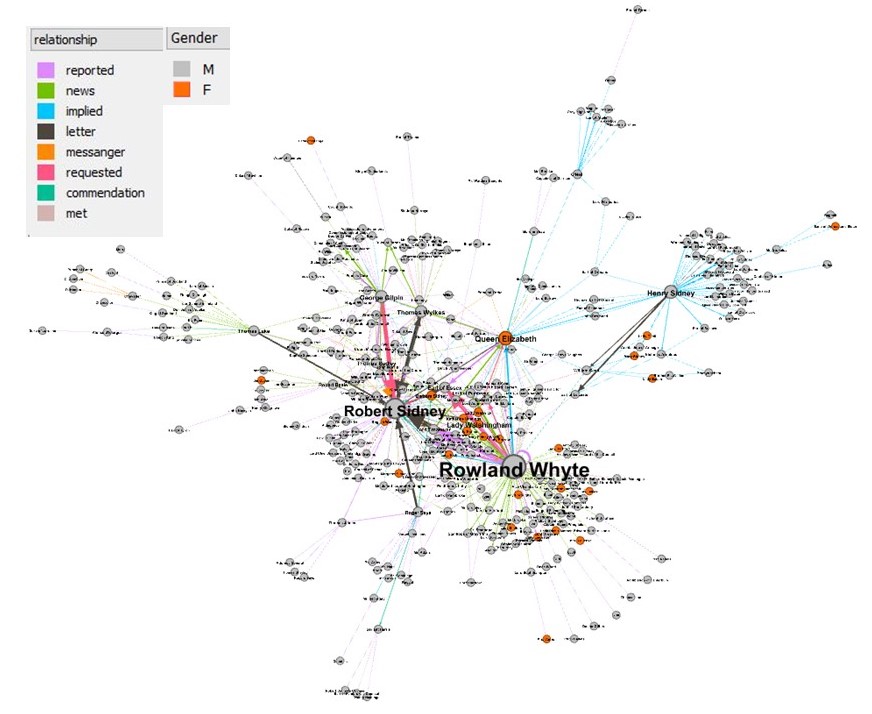
Figure 3. The Sidney network from 1565/1566, 1590, and 1595 visualized using Gephi. Edges are colored according to connection type, and nodes are colored by gender (men are gray, women are orange).
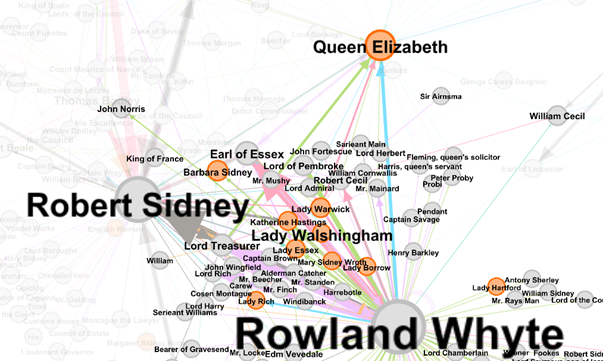
Figure 4. A group of ladies—Barbra Sidney, Katherine Hastings, Lady Warwick, Lady Walsingham, Lady Essex, Mary Sidney Wroth, and Lady Borrow—are between Robert Sidney, Rowland Whyte, and Queen Elizabeth.
Location in HSS Commons repository
Please see 'Notes' below for any suggested/official citation information added by the author(s) of this work. Otherwise, you can cite the HSS Commons instance of this publication as follows:
- Catherine Medici, (2026), "Supplementary Material of ‘Visualizing the Sidney Network: Using Network Analysis to Understand Women’s Place.’", HSSCommons: (DOI: 10.25547/NQ4W-TS97)
Tags
Notes
Medici, Catherine. 2025. “Visualizing the Sidney Network: Using Network Analysis to Understand Women’s Place.” In New Technologies and Renaissance Studies IV: The Changing Shape of Digital Early Modern Studies, edited by Randa El Khatib and Caroline Winter, 15–34. New Technologies in Medieval and Renaissance Studies 12. Iter Press. https://iterpress.org/9781649591197/new-technologies-and-renaissance-studies-iv/.
Publication preview
Iter Community
This publication belongs to the Iter Community group.
When watching a publication, you will be notified when a new version is released.